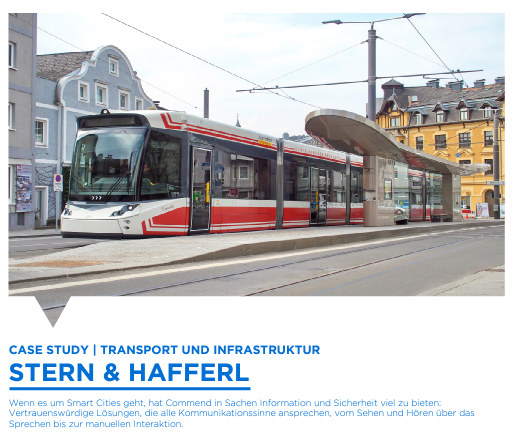
CASE STUDY | TRANSPORT AND INFRASTRUCTURE STERN & HAFFERL
CASE STUDY | TRANSPORTATION AND INFRASTRUCTURE - STERN & HAFFERL
When it comes to smart cities, Commend has a lot to offer in terms of information and security: Trustworthy solutions that appeal to all communication senses, from seeing and hearing to speaking and manual interaction.
Challenge:
Stern & Hafferl already had existing displays in the streetcar stops in Gmunden. However, these were getting on in years and the customer wanted a state-of-the-art solution: 46-inch display panels with an intercom solution integrated into the housing that can be operated by touch. The solution should enable passengers to establish a conversation with the dispatcher as easily as possible. At the same time, the dispatcher should be able to view the platform from the control center. During implementation, particular attention was also paid to passengers with visual and hearing impairments so that they can use the Stern & Hafferl service as flexibly as possible. A particular challenge was to combine the requirements of the solution and integrate the associated interfaces.
Solution:
The result is a 46-inch full-HD display system with its own operating layout. Commend provided the complete communication infrastructure for the intercom unit integrated into the housing of the all-round solution.
The result:
Stern & Hafferl now has a state-of-the-art display system that is characterized in particular by an easy-to-use operating menu that visually supports and thus facilitates calls to the control center. There is also enough space on the 46-inch display to visualize the timetables, as well as to play additional information and even advertising. These features make the solution unique:
Suitable for adverse environmental conditions and therefore ideal for outdoor use. Data and privacy protection through IP Secure Connector. Expansion modules for additional inputs to ensure that the solution remains state-of-the-art in the future. Speaker with special membrane for particularly high volumes and perfect voice quality. Barrier-free communication thanks to text-to-speech function: In addition, a particularly easily recognizable software button ensures that people with visual impairments can simply have the information read out to them. Currently, the intercom function is mainly used for service calls, such as questions about the timetable. This comprehensive solution approach is becoming increasingly established for smart cities and the combination can also be transferred to other applications.
The case study can be found here:
DE: https://clibrary.commend.com/en/dl/fb6c9f5e98a6bc017467f842b9efbec8349021b5-4543-dl/mediaportal.html
EN: https://clibrary.commend.com/en/dl/346e0d72d1ba1c23c3b72b955d470b721decce63-4543-dl/mediaportal.html